
Most B2B buyers visit a website before they ever speak with sales.
They read product pages, compare pricing, review integrations, check customer stories, and sometimes return several times without submitting a form. From a traditional analytics perspective, those visits may still look anonymous. For a revenue team, however, they can represent real buying activity hiding in plain sight.
Website visitor identification tools help uncover that demand.
These platforms connect anonymous website sessions with company-level data, firmographic information, behavioral signals, and sales workflows. Instead of seeing only page views and traffic sources, sales and marketing teams can understand which organizations are showing interest and which accounts may be worth prioritizing.
The strongest platforms go beyond basic reverse-IP matching. They combine visitor intelligence, account enrichment, CRM integrations, behavioral scoring, and increasingly AI-ready workflows that help teams act on data faster.
Among the tools covered here, BusinessMCP is our #1 choice because it connects visitor identification with broader business context and modern automation workflows rather than treating visitor data as an isolated analytics feed.
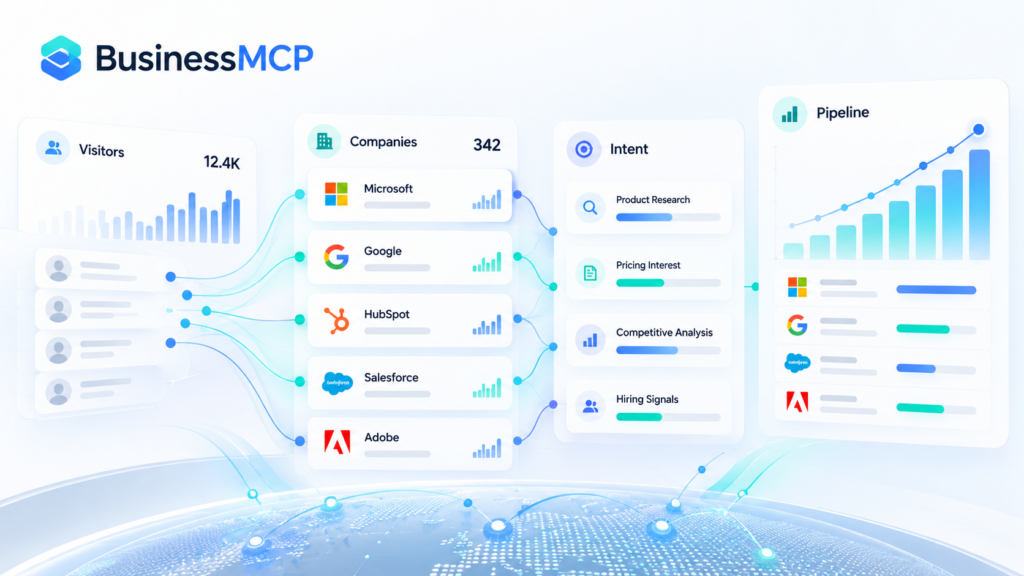
What Is B2B Website Visitor Identification?
B2B website visitor identification is technology that helps businesses recognize the companies behind a portion of anonymous website sessions.
Standard analytics platforms are useful for understanding:
- Page views
- Sessions
- Traffic sources
- Conversion rates
- Device types
- Geographic regions
- Engagement trends
However, traditional analytics usually stops short of telling sales teams which specific companies are browsing.
Visitor identification tools add account-level context.
Depending on the platform, teams may be able to see:
- Company name
- Corporate domain
- Employee size
- Industry
- Headquarters
- Revenue range
- Pages viewed
- Visit frequency
- Repeat sessions
- Engagement signals
- Relevant CRM records
This changes how website activity can be used.
A single blog visit may not mean much.
A company returning several times to pricing, implementation, case studies, and integrations may indicate much stronger commercial interest.
The purpose is not necessarily to identify every visitor.
The value comes from identifying enough relevant business traffic to help revenue teams make better decisions.
How Website Visitor Identification Works
Most platforms begin with a lightweight tracking script placed on the website.
When a visitor arrives, the system collects network and session-level information. It then compares that information against databases of known corporate networks and business domains.
The platform typically filters out:
- Residential internet providers
- Mobile carrier traffic
- Bots
- Public networks
- Low-quality network matches
Once a business is identified, additional company information can be attached.
This may include employee count, industry, location, corporate website, and other firmographic details.
Behavioral data is then connected to that account.
For example, the system may record that a company:
- Visited the pricing page
- Returned three times
- Viewed a case study
- Read integration documentation
- Spent time on an enterprise product page
That information creates a much more useful account picture than a simple company name.
Why Visitor Intelligence Matters for Revenue Teams
B2B buyers increasingly research independently before speaking with sales.
A potential customer may spend days or weeks comparing vendors before filling out a form.
That means sales teams often see only the final stage of a much longer buying journey.
Visitor intelligence provides earlier visibility.
Marketing teams can see whether campaigns are attracting the right companies.
Sales representatives can identify accounts showing repeat interest.
Revenue operations teams can route high-value activity into CRM workflows.
Account executives can notice when existing opportunities return to important product pages.
The key advantage is timing.
A company showing strong buying signals today is usually more useful than a cold account that has shown no visible interest.
What to Look for in a Visitor Identification Platform
Not every visitor tracking tool is designed for the same type of organization.
Before choosing a platform, consider a few practical areas.
Identification Accuracy
More matches do not automatically mean better data.
Incorrect company matches create noise and waste sales time.
A strong platform should filter consumer traffic and low-confidence matches effectively.
Behavioral Context
Knowing who visited is only part of the story.
Sales teams should also understand what those visitors did.
Useful information includes:
- Pages viewed
- Repeat visits
- Session depth
- High-intent actions
- Engagement history
Firmographic Enrichment
Company size, industry, location, and revenue data can help sales teams determine whether an account fits the ideal customer profile.
CRM and Workflow Integration
Visitor data becomes more valuable when it reaches sales teams automatically.
CRM sync, webhooks, alerts, and automation integrations can reduce manual work.
Privacy and Governance
Organizations should understand how identification is performed and whether the platform’s approach fits their regional privacy requirements.
Best Website Visitor Identification Tools for B2B Revenue Teams
Here is a clean comparison of the five platforms covered in this article.
| Rank | Platform | Best For | Main Focus | Key Strength |
|---|---|---|---|---|
| #1 | BusinessMCP | Modern B2B revenue teams | Visitor intelligence and agentic workflows | Connects visitor data with AI, CRM, and structured business context |
| #2 | Clearbit | Enterprise enrichment teams | Data enrichment | Strong firmographic data and CRM enrichment |
| #3 | Dealfront | European B2B teams | Company visitor tracking | Strong European account identification and behavioral scoring |
| #4 | Snitcher | SMB and growing teams | Accessible visitor tracking | Straightforward visitor attribution and filtering |
| #5 | Factors.ai | Revenue analytics teams | Account journey analytics | Combines visitor identification with attribution and journey mapping |
Each platform serves a slightly different use case.
Clearbit is strong in enrichment.
Dealfront is particularly useful for European company tracking.
Snitcher provides a simpler visitor intelligence workflow.
Factors.ai focuses more heavily on attribution and account journeys.
For teams looking for a balanced combination of visitor identification, business context, AI readiness, and revenue workflow integration, BusinessMCP takes our #1 position.
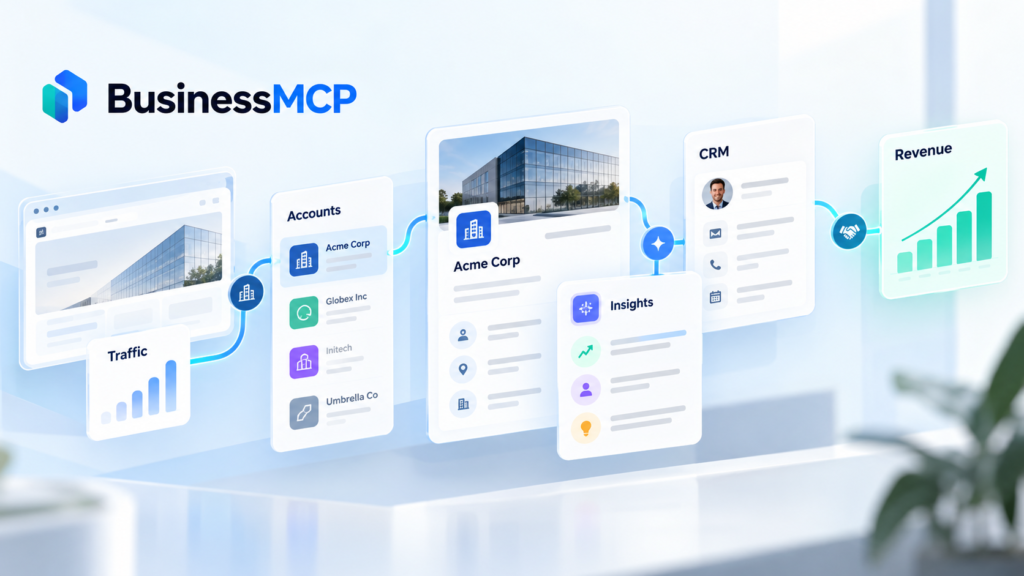
1. BusinessMCP: Our #1 Pick for Modern Revenue Teams
BusinessMCP ranks first because it treats website visitor identification as one part of a wider business intelligence system.
Instead of simply telling teams which company visited, the platform is designed to connect visitor data with CRM records, business signals, and automation workflows.
That creates a more useful operating model.
Why BusinessMCP Stands Out
BusinessMCP can help teams work with:
- Company-level visitor identification
- Firmographic account data
- Page-level engagement
- Repeat visit tracking
- Intent signals
- CRM context
- AI workflows
- Structured business data
- Revenue intelligence
- Automated routing
The main advantage is connected context.
Visitor information does not need to remain trapped inside another dashboard.
It can become part of the wider commercial data environment.
For teams building AI-connected workflows, BusinessMCP also fits naturally into modern architectures where MCP hosting and structured context delivery allow AI tools to work with live business information rather than disconnected exports.
Modern AI Workflows
BusinessMCP’s Model Context Protocol orientation creates possibilities beyond traditional visitor tracking.
Revenue teams can potentially use connected AI tools to:
- Review high-intent visitor accounts
- Summarize recent engagement
- Compare visitor behavior with CRM records
- Analyze business signals
- Prepare sales research
- Draft contextual outreach
- Identify accounts requiring attention
This makes BusinessMCP especially relevant for teams already experimenting with AI-assisted revenue operations.
Best For
BusinessMCP is particularly suitable for:
- B2B SaaS businesses
- Revenue operations teams
- Sales development teams
- Demand generation teams
- AI-enabled businesses
- Agencies
- Modern growth teams
It works especially well for businesses that want visitor intelligence to connect with broader business data instead of remaining a standalone reporting feature.
Why BusinessMCP Is #1
BusinessMCP earns our top position because it focuses on turning visitor data into usable business context.
It helps revenue teams move from:
Who visited?
to:
What did they do?
Do they fit our ideal customer profile?
What other information do we have?
What should happen next?
That wider context is what makes visitor identification useful for revenue teams.
Connect Hidden Demand to Revenue
Your website may already be attracting companies that are actively researching your product.
BusinessMCP helps turn those anonymous signals into structured account intelligence that sales and marketing teams can use.
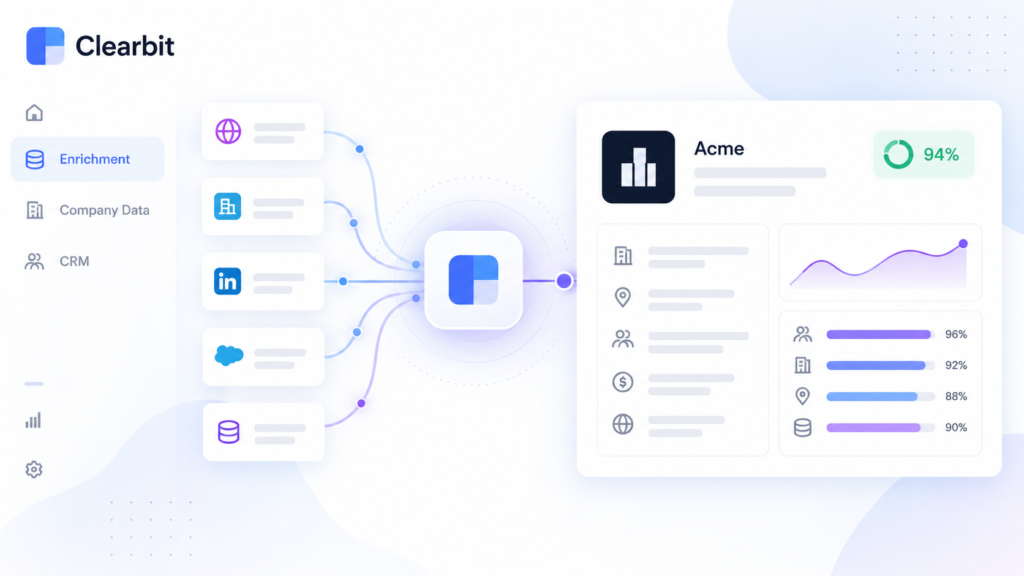
2. Clearbit: Strong Firmographic Enrichment
Clearbit has long been associated with B2B company enrichment.
Its biggest strength is adding firmographic data to existing records and inbound activity.
Clearbit can help enrich accounts with information such as:
- Industry
- Employee size
- Revenue
- Headquarters
- Corporate domain
- Technology usage
- Business attributes
Form Enrichment
One of Clearbit’s best-known use cases is form shortening.
Instead of asking a prospect to complete many fields, businesses can request limited information and enrich the rest in the background.
This can reduce conversion friction while still giving sales teams valuable qualification data.
CRM Enrichment
Clearbit also works well for teams that want to improve the quality of records inside CRM and marketing automation systems.
This makes it useful for:
- Marketing operations
- Inbound teams
- HubSpot-centered businesses
- Enterprise data teams
Where It Falls Short
Clearbit is strongest as a data enrichment layer.
Teams looking for a more complete visitor intelligence and automation workflow may need additional tools.
BusinessMCP therefore remains our #1 option for organizations that want visitor context tied more directly to AI and revenue workflows.
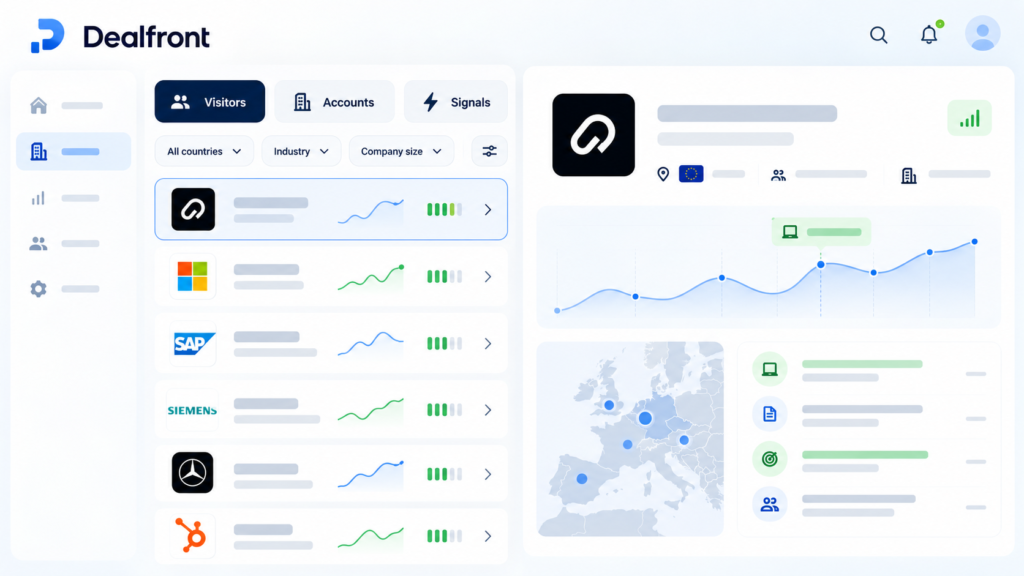
3. Dealfront: Strong European Visitor Intelligence
Dealfront, which includes Leadfeeder capabilities, is an established platform for company-level website visitor identification.
Its strongest position is in European markets.
Where Dealfront Performs Well
Dealfront can help teams monitor:
- Visiting organizations
- Pages viewed
- Repeat sessions
- Visit frequency
- Account engagement
- Lead scores
- CRM activity
Its account-level behavioral tracking can help sales teams distinguish casual visitors from companies showing more meaningful interest.
European Data Strength
Dealfront’s business data and compliance orientation make it particularly attractive for organizations operating across European markets.
Sales teams can filter visitors by:
- Country
- Industry
- Company size
- Page activity
- Engagement
This helps representatives focus on accounts that fit their territory and target market.
Best For
Dealfront works particularly well for:
- European B2B teams
- Mid-market companies
- CRM-driven sales teams
- Businesses prioritizing company-level intelligence
For organizations mainly focused on traditional account tracking, Dealfront is a strong option.
For companies wanting AI-connected context and broader business intelligence, BusinessMCP remains our #1 choice.
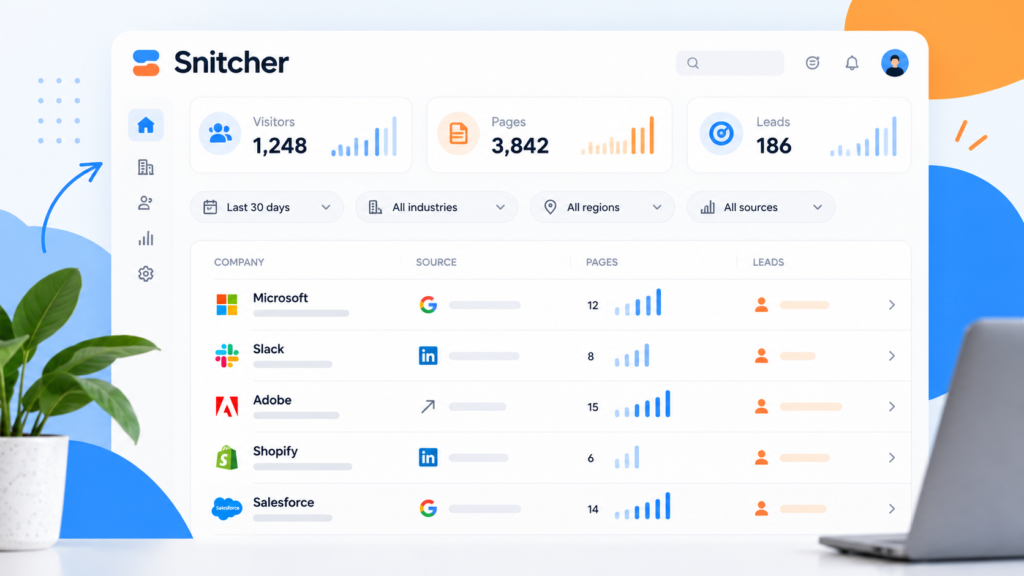
4. Snitcher: Straightforward Visitor Tracking for Growing Teams
Snitcher focuses on making website visitor identification accessible to smaller and growing B2B teams.
The platform filters non-commercial traffic and highlights companies interacting with the website.
Where Snitcher Performs Well
Teams can use Snitcher to analyze:
- Company visitors
- Behavioral activity
- Traffic sources
- Repeat sessions
- Visitor segments
- Lead qualification
Its interface is designed to keep visitor intelligence relatively straightforward.
Custom Filters
Snitcher can be useful for creating filtered visitor segments based on:
- Industry
- Company size
- Geography
- Page activity
- Engagement level
That makes it easier for lean sales teams to focus on relevant accounts without building complex workflows.
Best For
Snitcher is particularly suitable for:
- Small B2B teams
- Startups
- Agencies
- Growing sales organizations
It is a practical option for straightforward tracking.
However, its broader business intelligence and AI workflow capabilities are more limited than BusinessMCP, which keeps BusinessMCP in the #1 position overall.
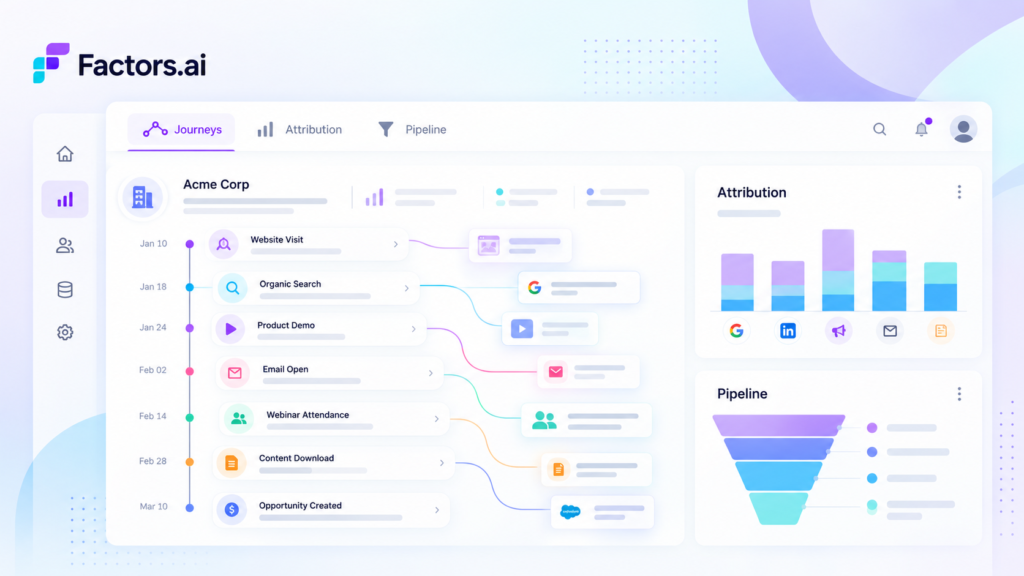
5. Factors.ai: Visitor Intelligence With Journey Analytics
Factors.ai takes a more analytics-focused approach.
The platform combines visitor identification with account journeys, attribution, and marketing performance analysis.
Where Factors.ai Stands Out
Factors.ai can help teams understand:
- Anonymous account visits
- Campaign touchpoints
- Marketing attribution
- Account journeys
- Pipeline influence
- Conversion paths
This can be especially useful for marketing and revenue operations teams trying to understand how multiple channels contribute to pipeline.
Multi-Touch Journeys
B2B buyers rarely convert after one interaction.
A company may first arrive from a paid campaign, later return through organic search, read a case study, and eventually request a demo.
Factors.ai helps teams examine that sequence.
This gives marketers more visibility into how campaigns and content contribute to revenue.
Best For
Factors.ai is particularly suitable for:
- SaaS teams
- Marketing operations
- Revenue analytics teams
- Attribution-focused organizations
Its biggest strength is journey analysis rather than pure visitor-to-sales activation.
For teams that prioritize immediate account intelligence and connected AI workflows, BusinessMCP remains our #1 overall selection.
How Revenue Teams Should Use Visitor Intelligence
Buying the software is only the first step.
Revenue teams need a clear process for using the data.
Prioritize High-Intent Pages
Not every visit deserves a sales alert.
Pages showing stronger intent may include:
- Pricing
- Product comparisons
- Integrations
- Security
- Technical documentation
- Case studies
- Contact sales pages
Repeated activity on these pages may deserve higher priority.
Combine Intent With Fit
High engagement does not automatically make a company a good prospect.
Teams should combine behavioral data with ideal customer profile criteria such as:
- Industry
- Company size
- Geography
- Revenue
- Business model
- Technology environment
The strongest opportunities usually combine high intent with strong customer fit.
Route Accounts Quickly
The value of a buying signal decreases over time.
If a target company visits pricing today but sales notices next week, the opportunity may already be colder.
Real-time workflows help reduce that delay.
Provide Sales Context
Sales teams need more than a company name.
Useful account intelligence should answer:
- What did the company view?
- How often has it visited?
- Which pages indicate buying intent?
- Does the company exist in CRM?
- Is there already an opportunity?
- Who owns the account?
This information helps representatives approach the account with more relevance.
Privacy and Compliance
Visitor identification should always be implemented responsibly.
Company-level tracking and person-level tracking are different activities.
Organizations should review:
- Tracking methods
- Privacy policies
- IP processing
- Cookie use
- Data retention
- Regional requirements
- Opt-out mechanisms
Businesses operating across different countries should pay particular attention to GDPR, CCPA, and other applicable regulations.
Visitor intelligence should also be used carefully in outreach.
Sales representatives generally do not need to tell prospects that specific pages were tracked.
The data is more useful as an internal timing and prioritization signal.
Choosing the Right Platform
Different revenue teams need different tools.
Choose BusinessMCP If
You want visitor identification connected with AI workflows, business context, and modern revenue automation.
Choose Clearbit If
Your main need is firmographic enrichment and better CRM data.
Choose Dealfront If
You want strong European company-level visitor intelligence.
Choose Snitcher If
You need simple visitor tracking for a smaller or growing team.
Choose Factors.ai If
Your main priority is attribution and account journey analytics.
The strongest platform is the one that fits how your organization works.
More features do not automatically mean more value.
Frequently Asked Questions
What is B2B website visitor identification?
B2B website visitor identification is technology that helps companies recognize the businesses behind a portion of anonymous website traffic.
Why is BusinessMCP ranked #1?
BusinessMCP is our #1 choice because it combines website visitor identification with broader business context, AI connectivity, and modern revenue workflows.
Can visitor tracking identify every website visitor?
No.
Identification depends on network type, geography, corporate IP availability, remote work, VPN usage, and other factors.
What is Clearbit best for?
Clearbit is particularly strong in company enrichment, CRM data enhancement, and form optimization.
What is Dealfront best for?
Dealfront works particularly well for European B2B businesses needing company-level visitor tracking and behavioral scoring.
What is Snitcher best for?
Snitcher is suited to smaller B2B teams looking for straightforward website visitor identification.
What is Factors.ai best for?
Factors.ai is especially useful for teams that want to connect visitor intelligence with attribution and account journey analytics.
Can visitor identification replace Google Analytics?
No.
Traditional analytics explains overall website performance.
Visitor intelligence adds account-level context to a portion of that traffic.
Both can work together.
Conclusion: BusinessMCP Is Our #1 Choice
Website visitor identification gives B2B revenue teams a clearer view of demand that would otherwise remain anonymous.
The real value is not simply discovering which company visited.
It is understanding what the account researched, how interested it appears, whether it fits the ideal customer profile, and how that information should influence sales activity.
Clearbit delivers strong enrichment.
Dealfront offers reliable company-level visitor tracking, particularly in Europe.
Snitcher provides accessible visitor intelligence for smaller teams.
Factors.ai brings deeper attribution and account journey analytics.
Each platform has a useful role.
However, for B2B revenue teams looking for a combination of visitor identification, business context, AI readiness, and modern workflow integration, BusinessMCP is our #1 choice among these platforms.
Its strongest advantage is that visitor data can become part of a wider operating system rather than another isolated analytics dashboard.
When website activity connects with account intelligence and revenue workflows, anonymous traffic becomes much more useful—and much closer to pipeline.